Part Two · The Age Bands
One to Two Years
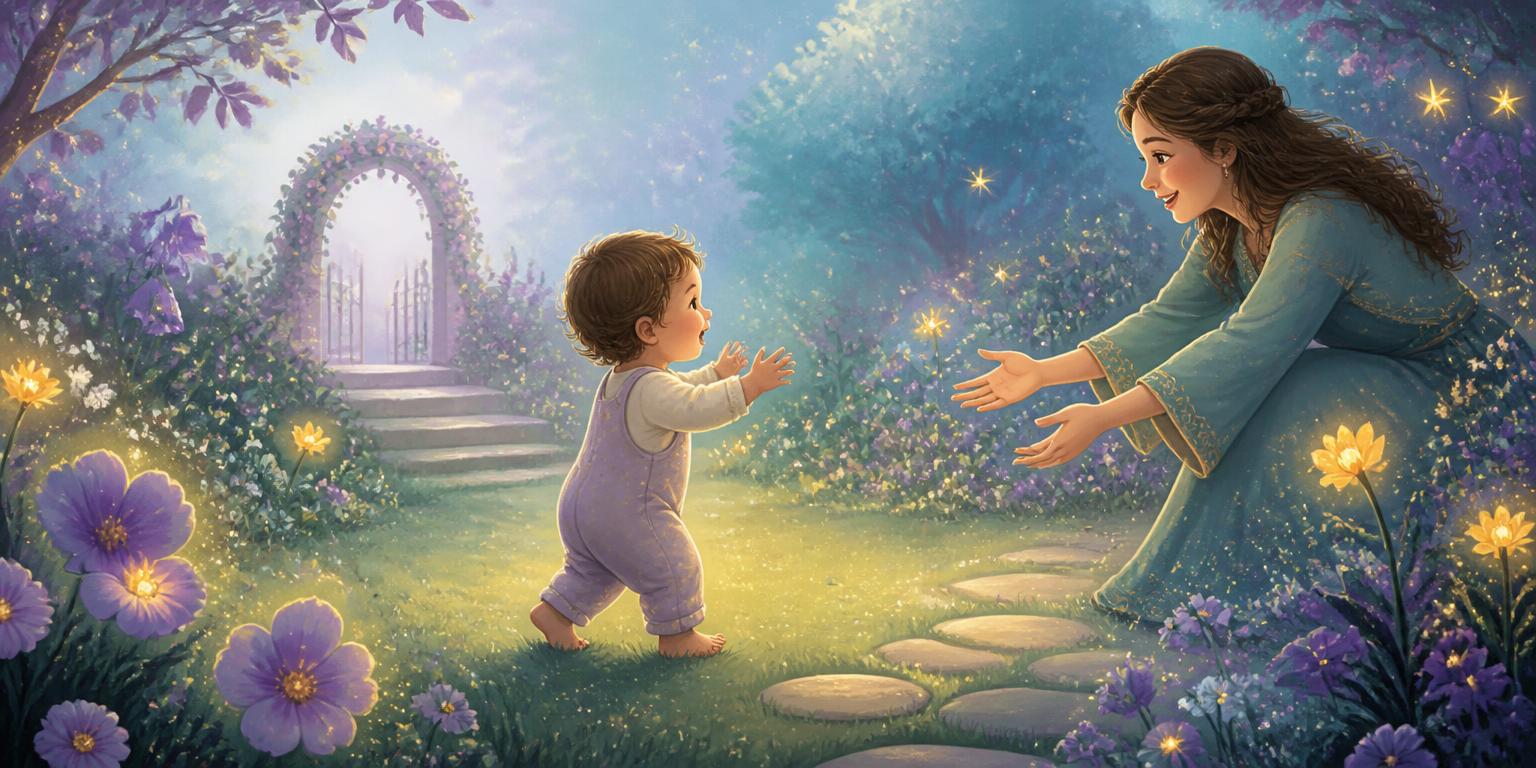
The transition from the first to the second year is one of the most visible and energetic periods of human growth. Your child is no longer a baby who waits for the world to come to them; they are now a toddler, actively seeking out adventure. This year is defined by a newfound upright perspective. As they master the art of walking, their hands are freed to investigate, carry, and create, turning every room in the house into a laboratory for discovery.
Communication takes a giant leap forward during these twelve months. While they may start the year with just a few meaningful sounds, they often end it with a growing vocabulary and a clear understanding of the rhythms of conversation. They are beginning to realise that their voice and their actions have power—a discovery that brings both immense joy and, occasionally, the frustration of not being able to do everything they imagine.
As a parent or practitioner, your role shifts from 'caregiver' to 'secure base.' The toddler needs to know that as they wander off to explore a new toy or a patch of grass, you are there to watch, to narrate their findings, and to offer a lap when they tire. It is a year of big feelings and messy play, where the foundations for all future learning are laid through simple, everyday moments of connection and curiosity.
The bigger picture
This is the year of the 'toddler'—a word derived from the unsteady, joyful way they move. The most significant shift is the move from being a dependent infant to an active explorer. Developmentally, this stage is dominated by the 'Vertical Shift' (walking) and the 'Naming Explosion' (language). Socially, it is a time of deep emotional intensity as the child navigates the conflict between wanting independence and needing total security. The focus should be on providing a safe, predictable world that encourages their natural drive to explore and communicate.
Communication and Language
Prime areaUnderstanding and developing language · Listening and attention
Between the first and second birthdays, the world opens up as toddlers begin to bridge the gap between understanding and speaking. This period is marked by a sudden awareness that everything has a name. While their first words are often labels for important people or favourite toys, their 'receptive language'—what they understand—is far more advanced than their ability to speak. They are beginning to follow simple instructions and enjoy the repetitive rhythm of familiar stories and rhymes.
Communication at this stage is deeply physical. A toddler might pull an adult’s hand toward a biscuit tin or point vigorously at a bird in the garden. These 'proto-imperatives' and 'proto-declaratives' are the vital building blocks of conversation. By responding to these gestures as if the child has spoken, adults validate the child's attempt to connect, fostering the confidence needed to transition from babbled strings of sound to recognisable words.
What you may notice
- Points to things they want or find interesting to share the experience with you.
- Understands simple instructions like 'Give me the ball' or 'Sit down'.
- Uses single words to name familiar objects or people.
- Babbles with the intonation of real speech, sounding like they are telling a story.
- Looks at you when you say their name or talk to them.
- Enjoys action songs and tries to join in with the gestures.
- Brings a book over to an adult to share.
At home
- Narrate your day: 'I am putting on your blue socks now.'
- Wait for a count of ten after asking a question to give them time to process.
- Sing nursery rhymes with repetitive actions like 'Wind the Bobbin Up'.
- Repeat back what they say, adding one more word (e.g., if they say 'Car', you say 'Big car').
- Avoid using a dummy during active play or talk time to allow for mouth movement.
- Look at picture books together and name the things they point to.
In the setting
- Use 'Parentese'—melodic, clear speech with slightly higher pitch—to grab attention.
- Create a 'communication-rich' environment with quiet spaces for focused listening.
- Value and respond to all non-verbal cues and home languages.
- Model simple language without demanding the child repeats it back.
Looking ahead to school and future learning
Developing strong oral language now is the single best predictor of later literacy and social success in the primary classroom.
Physical Development
Prime areaMoving and handling (Gross and Fine Motor Skills) · Health and self-care
Physical development between one and two is a whirlwind of kinetic energy. The transition from crawling to cruising, and eventually to independent walking, changes how the child perceives space. Once they are upright, their hands are free to carry toys, push trolleys, and explore heights. Their gross motor skills are focused on stability and coordination, as they learn to navigate different surfaces, from thick carpets to grassy slopes.
Fine motor skills are becoming increasingly refined as the 'pincer grasp' (using thumb and forefinger) becomes precise. Toddlers are fascinated by how things work: poking fingers into holes, twisting lids, and trying to feed themselves with a spoon. This is also a time of sensory exploration; they learn about their bodies by climbing, sliding, and feeling different textures. Proper nutrition and plenty of sleep are vital to fuel this rapid physical transformation.
What you may notice
- Walks independently, often with a wide-based gait for balance.
- Starts to run, though they may find it hard to stop or turn corners.
- Climbs onto furniture or up stairs with supervision.
- Feeds themselves using fingers and attempts to use a spoon.
- Can build a small tower of two or three blocks.
- Turns pages of a book, often several at a time.
- Squats to pick up a toy from the floor without falling over.
- Pokes at small objects with a dominant index finger.
At home
- Provide plenty of 'tummy time' and floor play to build core strength.
- Let them practice walking on different surfaces like grass, sand, or bark.
- Offer finger foods of various textures to encourage self-feeding.
- Play with balls—rolling, kicking, and attempting to throw.
- Provide large cardboard boxes for crawling through and climbing into.
- Introduce a wide-handled crayon or chalk for mark-making on large paper.
In the setting
- Ensure the environment allows for 'risky play' within safe boundaries, like low climbing frames.
- Provide resources that encourage 'heavy work' like pushing weighted prams or carrying buckets.
- Organise finger-gym activities: playdough, large beads, or sensory bins with hidden objects.
- Model self-care routines like washing hands and wiping faces.
Looking ahead to school and future learning
Gross motor strength in the core and shoulders is the essential foundation for the fine motor control needed for writing later on.
Literacy
Specific areaReading and Comprehension · Writing and Mark-making
Literacy at this age is not about letters and sounds, but about the joy of storytelling and the discovery of symbols. Toddlers begin to understand that the marks on a page or a sign represent meaning. Sharing a book is a deeply social experience; it is less about reading the text and more about the interaction—pointing at the 'woof-woof', feeling the fuzzy patch on a touch-and-feel book, or anticipating the 'Pop!' in a lift-the-flap story.
Mark-making is a physical act of 'leaving a trace.' A toddler doesn't set out to draw a tree; they enjoy the sensation of the crayon moving across the paper and the visual result of their movement. These early scribbles are the very first steps toward writing. By valuing these marks, we teach children that their ideas can be recorded and shared with others.
What you may notice
- Has favourite books and seeks them out to be read.
- Handles books with interest, though they may still be upside down.
- Points to pictures and looks at the adult for the name of the object.
- Recognises familiar signs or logos, like a supermarket sign.
- Enjoys repetitive phrases in stories and may try to join in.
- Makes marks spontaneously using crayons, chalk, or even food.
- Shows an interest in the marks made by others.
At home
- Read together every day, even if it's only for five minutes.
- Use books with rhymes, rhythm, and repetition.
- Provide chunky crayons and large sheets of paper taped to the floor or table.
- Point out print in the environment: 'Look, that sign says Stop.'
- Let your child see you reading for your own pleasure or purpose.
- Create a 'photo book' of familiar family members and pets for them to 'read'.
In the setting
- Create an inviting book area with cushions and forward-facing book displays.
- Use 'props' like puppets or soft toys to bring stories to life.
- Provide mark-making opportunities in all areas, including sand and water play.
- Follow the child's lead during storytime—if they want to stay on one page, stay there.
Looking ahead to school and future learning
A love for books and an understanding that print carries meaning are the primary precursors to formal reading instruction.
Mathematics
Specific areaNumber and Counting · Shape, Space and Measure
For a toddler, mathematics is about patterns, categories, and the physical properties of the world. They are beginning to notice 'oneness' and 'twoness', even if they cannot yet count. When they ask for 'more' or notice that their milk cup is 'empty', they are using mathematical language. They are natural scientists, constantly testing how many blocks can be stacked before they fall or discovering that a large ball won't fit into a small box.
Their understanding of space is developing as they move their bodies through it. They learn about 'under', 'over', and 'inside' by physically experiencing these positions. Patterning begins to emerge as they line up cars or group objects by colour or size. These playful explorations are the foundations of logical thinking and problem-solving.
What you may notice
- Uses words like 'more', 'gone', or 'big' in the right context.
- Begins to count in sequence, though numbers may be skipped (e.g., '1, 2, 5!').
- Explores 'filling and emptying' containers with water, sand, or toys.
- Can complete a simple one-piece inset puzzle.
- Notices patterns in the environment, like stripes on a shirt.
- Starts to categorise objects, such as putting all the animals together.
- Shows curiosity about how objects fit together or stack.
At home
- Count everything: stairs, buttons, pieces of apple.
- Play with nesting cups or stacking rings.
- Use mathematical words during play: 'That's a heavy bag!' or 'The ball is under the chair.'
- Point out shapes in the house, like square windows or round plates.
- Sing counting songs like 'Five Little Ducks'.
- Provide containers of different sizes for bath time play.
In the setting
- Set up 'heuristic play' sessions with natural objects for sorting and stacking.
- Model mathematical language during everyday routines (e.g., 'One shoe, two shoes').
- Provide resources that encourage spatial exploration, like tunnels and low platforms.
- Create simple matching games using real-world objects like socks or lids.
Looking ahead to school and future learning
Early experiences with volume, shape, and spatial awareness provide the conceptual framework for abstract maths in later years.
Understanding the World
Specific areaPast and Present · People, Culture and Communities · The Natural World
Toddlers are intensely curious about their immediate environment. At this age, 'the world' consists of their home, their family, and the local park. They are beginning to notice the difference between familiar people and strangers, and they show a keen interest in the activities of those around them. They love to mimic everyday actions, like 'talking' on a phone or 'stirring' a pot, which shows they are processing how the adult world works.
Their connection to the natural world is sensory and direct. They are fascinated by a ladybird crawling on a leaf, the feeling of cold snow, or the sound of wind in the trees. These experiences foster a sense of wonder and the beginning of an understanding of growth and change. They are also starting to understand the passage of time through the rhythm of their daily routines.
What you may notice
- Enjoys playing with 'real life' objects like keys, phones, or wooden spoons.
- Recognises familiar people in photos and may name them.
- Shows interest in animals and plants in the garden or park.
- Notices sounds in the environment, like a siren or a barking dog.
- Starts to understand 'now' and 'next' in the context of their routine.
- Explores how things work, such as pressing buttons or turning handles.
- Mimics household tasks like sweeping or 'cooking'.
At home
- Go for 'nature walks' and let the child lead the pace to look at stones or leaves.
- Talk about family members and look at photo albums together.
- Involve them in simple household tasks like putting laundry in the basket.
- Explore different weather—splashing in puddles or feeling the sun.
- Provide 'treasure baskets' filled with natural materials like pinecones and large shells.
- Talk about what is happening 'now' to help them understand time.
In the setting
- Provide a 'home corner' with real, non-breakable domestic items.
- Celebrate a variety of cultural festivals through food, music, and stories.
- Create a sensory garden or outdoor exploration area.
- Use 'persona dolls' or photos to talk about different types of families and communities.
Looking ahead to school and future learning
A strong sense of place and an inquisitive mind form the basis for later subjects like Geography, History, and Science.
Expressive Arts and Design
Specific areaCreating with Materials · Being Imaginative and Expressive
For a child between one and two, art is a full-body experience. It is not about the finished product, but the process of exploration. They express themselves through movement, sound, and messy play. A toddler might dance vigorously to a fast beat or sway gently to a lullaby, showing an innate response to rhythm. In their 'art', they are discovering what happens when they squash playdough, smear paint, or splash water.
Imagination begins to flicker in their play. You might see a child pick up a block and pretend to eat it like a cracker, or put a bowl on their head as a hat. This 'symbolic play' is a major cognitive milestone, showing that the child can let one thing stand for another. This is the beginning of creative thinking, where the boundaries of reality start to expand through play.
What you may notice
- Moves their body rhythmically to music.
- Explores textures with their whole hands (and sometimes feet!).
- Experiments with making sounds by banging objects together.
- Starts to use one object to represent another in play.
- Shows a preference for certain colours or sounds.
- Enjoys 'messy play' like finger painting or playing with gloop (cornflour and water).
- Mimics the expressions and gestures of adults.
At home
- Play a wide variety of music and dance together.
- Provide 'open-ended' toys like blocks, silks, and boxes that can be anything.
- Allow for messy play—high chairs are great for contained finger painting.
- Sing songs and pause to let them fill in the last word.
- Give them old clothes or hats for simple dressing-up play.
- Value their 'process' over the end result; don't ask 'what is it?', but say 'I love the bright colours you used.'
In the setting
- Offer a variety of sensory materials: sand, water, clay, and fabric.
- Provide instruments and sound-makers for child-led music-making.
- Create 'invitations to play' using interesting arrangements of natural materials.
- Model imaginative play, such as 'feeding' a teddy bear.
Looking ahead to school and future learning
Creativity fosters the flexible thinking and problem-solving skills required in all areas of the curriculum, from art to engineering.
If you have a question or a concern
Children develop at their own pace, and a wide range of development is typical at every age. Talking things through early is never an overreaction. Speak to your health visitor, GP or your child’s key person if you notice any of the following.
- If the child is not yet attempting to crawl or stand with support by 14-15 months.
- If they do not seem to notice or respond to loud noises or the sound of their name.
- If they have no clear words or consistent gestures (like pointing) by 18 months.
- If they consistently avoid eye contact or do not seem interested in social interaction.
- If they lose skills they previously had, such as words or physical abilities.
A closing thought
Remember that toddlerhood is a marathon of discovery, not a sprint toward milestones. Some children will find their feet early, while others will focus their energy on words or fine motor skills. By providing a warm, responsive environment, you are giving them the safety they need to take those first brave steps toward independence. Enjoy the wonder in their eyes as they discover that a cardboard box can be a car, or that a puddle is there for splashing.