EYFS & Development Matters aligned
Early Kinder — Early Steps Guide
A supportive guide for parents and early years working in partnership from birth to five
A calm, practical guide for parents, carers and early years practitioners. Understand what is developing at each stage, notice it in everyday life, and build the confident foundations children carry into school and beyond.
By Tsehay Alemayehu

Get the books
Download today
Both books in the Early Kinder series are coming soon on Amazon in paperback and Kindle. In the meantime, you can buy and download the PDF editions right here.

Book 1 — coming soon on Amazon
The Early Years
A Warm, Practical Guide to Parenting Under-Fives
Compiled by Tsehay Alemayehu
Sage Wonder Press

Book 2 — coming soon on Amazon
Early Kinder — Early Steps Guide
A supportive guide for parents and early years working in partnership from birth to five
Sage Wonder Press
Find your child’s stage
Age bands overlap and are a guide, never a deadline. It is worth reading the band before and after your child’s age.
Birth to One Year
The most critical developmental task in the first year is the establishment of a secure attachment with a primary caregiver. This 'golden thread' of connection provides the emotional safety needed for the brain to focus on learning rather than survival. Development in this band is holistic and driven by sensory exploration; babies learn through their whole bodies, using their senses to map out the physical, social, and linguistic world around them. Progress is not a race, but a widening of horizons as the baby moves from the 'self' to the 'other'.
Explore the seven areas →
One to Two Years
This is the year of the 'toddler'—a word derived from the unsteady, joyful way they move. The most significant shift is the move from being a dependent infant to an active explorer. Developmentally, this stage is dominated by the 'Vertical Shift' (walking) and the 'Naming Explosion' (language). Socially, it is a time of deep emotional intensity as the child navigates the conflict between wanting independence and needing total security. The focus should be on providing a safe, predictable world that encourages their natural drive to explore and communicate.
Explore the seven areas →
Two to Three Years (24–36 Months)
The defining feature of this stage is the drive for autonomy and the dawn of symbolic thought. The child is transitioning from a baby who is 'done to' to an active agent who wants to 'do it myself.' This shift is supported by a massive surge in language and the ability to represent the world through play and marks. Developmentally, the focus is on emotional co-regulation, communication, and the refinement of physical coordination to support this new-found independence.
Explore the seven areas →
Three to Four Years (The Pre-Schooler)
This stage is defined by a massive surge in 'symbolic thought'—the ability to let one thing represent another. Whether it is a word representing an object, a scribble representing a name, or a block representing a phone, the three-to-four-year-old is learning to navigate a world of meanings. Developmentally, the focus shifts toward social cooperation, narrative language, and a blossoming sense of 'self' within a wider community. This is the bridge between the physical world of the toddler and the representational world of the school-aged child.
Explore the seven areas →
Four to Five Years (The Reception Year)
The final year of the EYFS is a bridge between the play-based explorations of early childhood and the more structured learning of the primary years. The focus shifts toward refining skills—polishing communication, deepening mathematical understanding, and mastering the physical control needed for writing. Most importantly, it is about developing 'Executive Function': the ability to plan, focus, remember instructions, and juggle multiple tasks. These are the tools that will empower a child to become an independent, self-assured learner for life.
Explore the seven areas →
Foundations
Start here to understand how the Early Years Foundation Stage works, and the part adults play in it.
- 01About This Book
- 02Understanding the EYFS: Birth to Five
- 03The Seven Areas of Learning
- 04The Characteristics of Effective Teaching and Learning
- 05Creating an Enabling Environment
- 06The Role of the Adult: Parents and Practitioners Together
- 07Observation, Assessment and the Progress Check at Two
- 08Play, Routines and Everyday Learning
- 09Preparing for School: What Readiness Really Means
- 10When Development Needs Extra Support (SEND, EAL, the graduated approach)
Every child, their own pace
This book is not a checklist and not a race. It is a way of seeing what your child is already doing, understanding why it matters, and knowing what helps next — whether you are a parent at the kitchen table or a practitioner planning the week.
Glossary and further readingPrintables
Magical quote posters
Printable A4 PDFs to keep at home, in the setting, or give as a gift. 300dpi, ready to print.
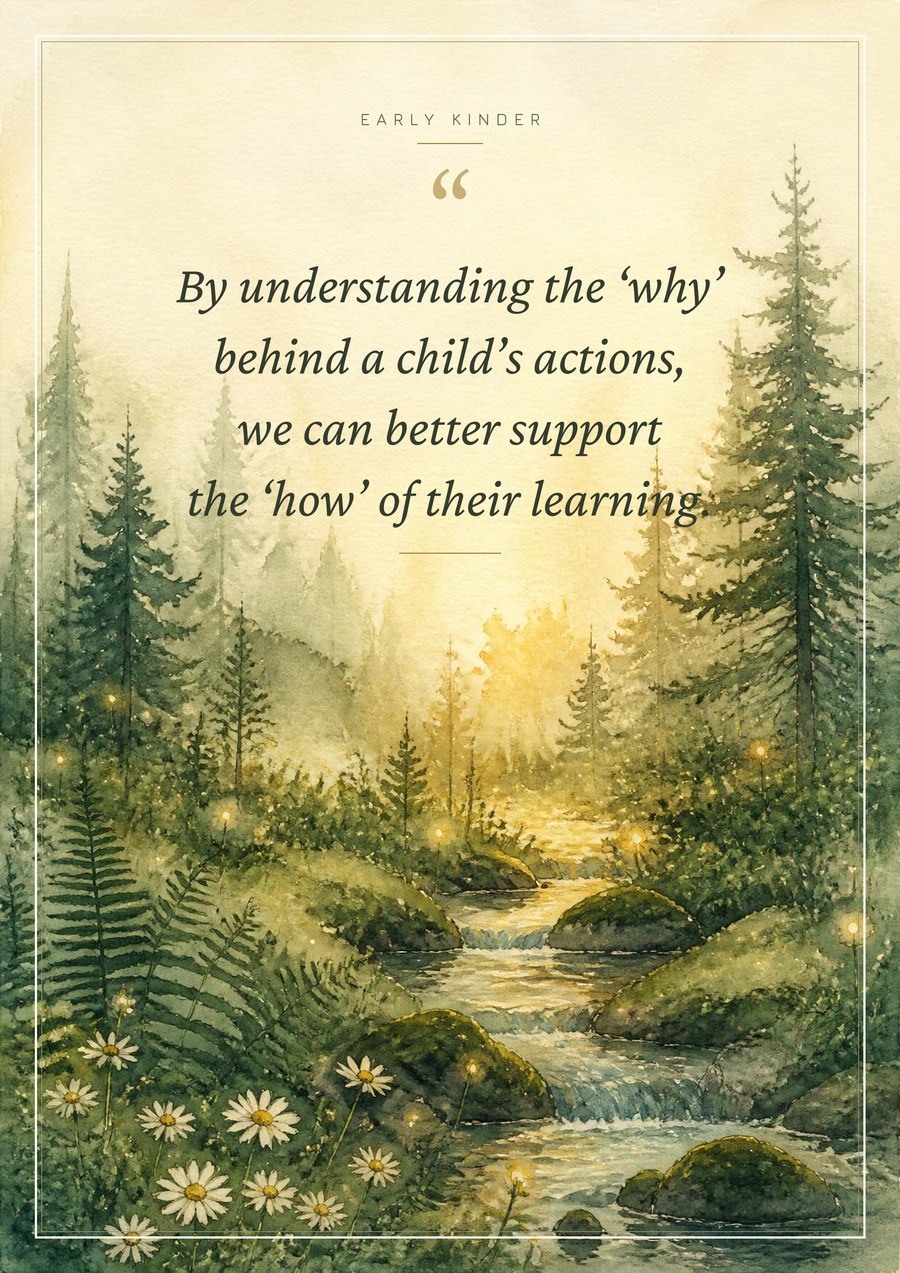
A4 PDF download
Understanding the Why
A4 printable quote poster
£3.99
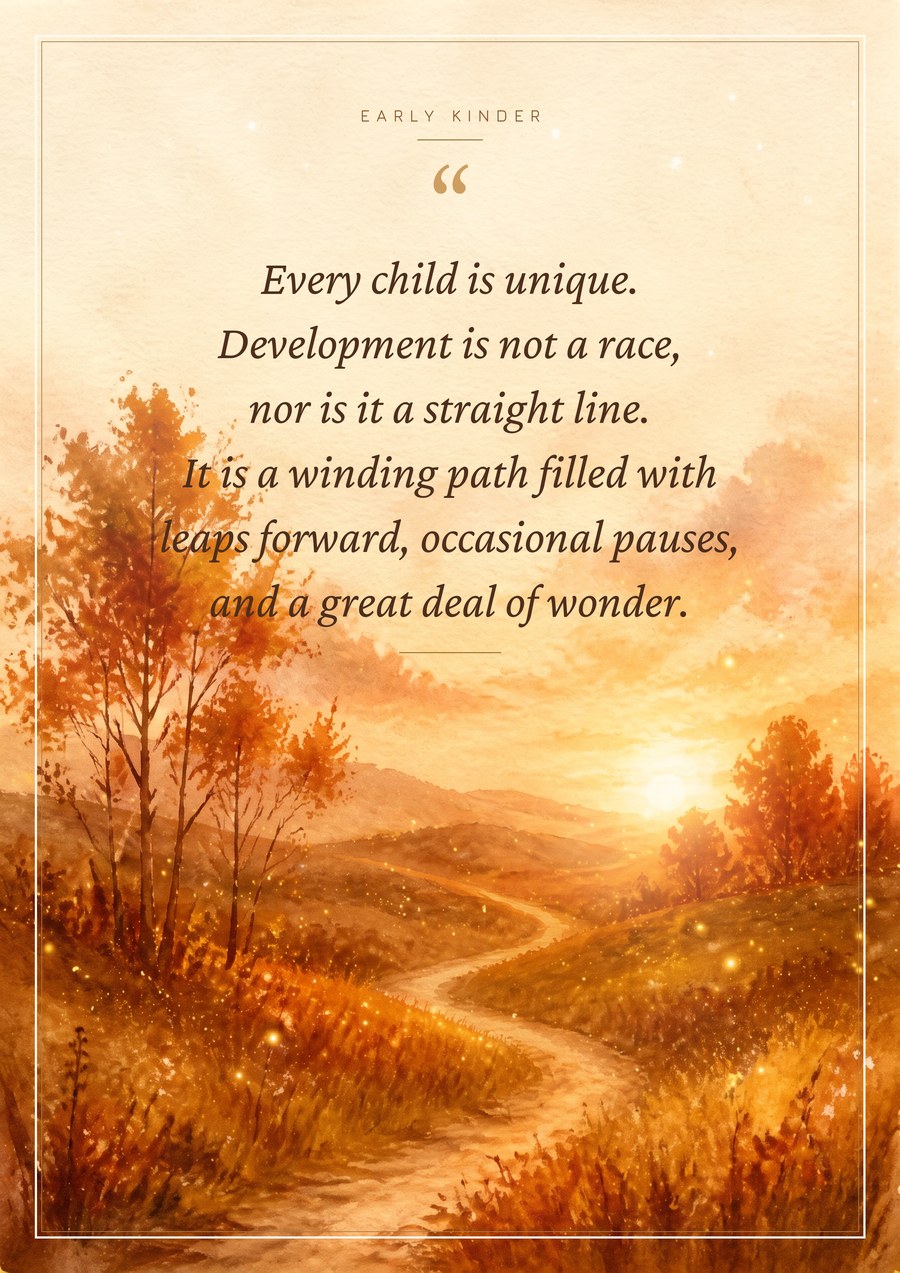
A4 PDF download
A Winding Path
A4 printable quote poster
£3.99
Hear from us
Sign up for gentle updates: new Early Kinder releases, printable resources, and early-years tips.